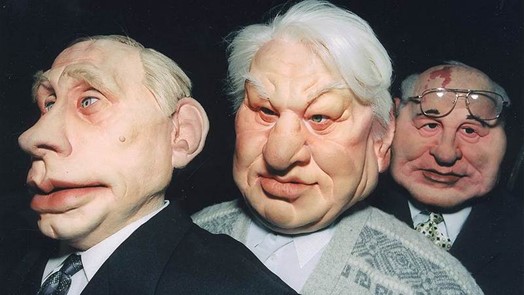
In the late 1990s, a now-legendary Russian political satire program called Kukly (“puppets” in English) used a cast of caricatures to lampoon Russian parliamentarians and President Boris Yeltsin. It drew record television audiences and plenty of political ire, much in the same way North American late-night comedy shows do. Neither the puppets or political satire, as it turned out, would survive Vladimir Putin.
Shortly after Putin’s appointment as president in 2000, the Kremlin’s irritation turned into repression. Journalists were branded enemies of the state, harassed. A Novaya Gazeta journalist, who was critical of the Kremlin, Igor Domnnikov, was beaten into a coma with a hammer five months after Putin’s inauguration and died a few months later. Kukly also landed at the top of the Kremlin’s political hit list. Putin’s allies demanded it be pulled off the air for “insulting the President.” The reason was obvious: the show was shaping public opinion more effectively than any of Putin’s political opponents, and he could not tolerate the ridicule. Kukly was pulled off the air by its broadcaster, citing business considerations, and with it, one of Russia’s most important cultural checks on power.
We failed to recognize those early warning signs of Putin’s authoritarian trajectory. We cannot afford to make the same mistake again.
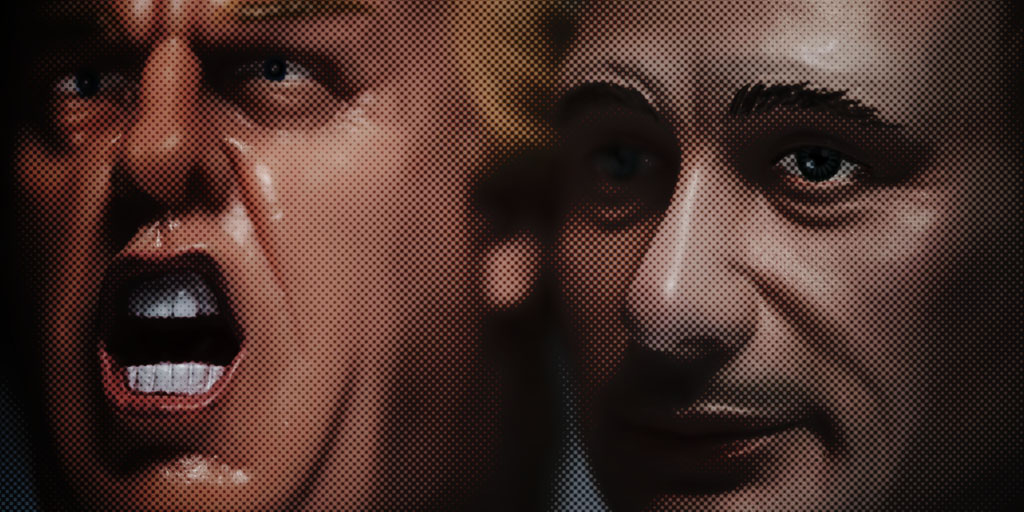
What once seemed unimaginable, that the United States could retreat from its role as the world’s foremost defender of freedom and democracy toward Putinist autocracy, has become disturbingly plausible. The “Putinization” of the U.S. under Donald Trump has become a creeping reality.
An Orwellian political environment is now taking shape in The United States, in which rhetoric about freedom and tolerance is paired with a campaign to intimidate and silence dissent and consolidate power.
The cancellation of late-night host Jimmy Kimmel is as much of a warning sign to Americans, as the cancellation of Kukly should have been for Russians. MAGA disciples who rail against “cancel culture” are eagerly deploying it themselves, targeting journalists and political opponents who challenge them, and even entertainers who dare to satirize the President.
The playbook Donald Trump is following is hardly original. It was drafted by Vladimir Putin a quarter century ago. From the moment he seized power, Putin launched a war on free expression, criminalized minority communities, outlawed opposition, and repressed critics. His regime made youth indoctrination a priority, building movements like Nashi to lure students into propaganda camps where opposition leaders and human rights defenders were branded as traitors.
At the same time, Putin moved to extinguish Russia’s free press. Independent outlets that dared to criticize the Kremlin were intimidated, raided and seized. Journalists were threatened and killed, many were driven into exile. Even oligarchs who dared to support civil society paid the price. Mikhail Khodorkovsky, once Russia’s richest man, was stripped of his fortune and locked away for nearly a decade. When a united opposition mobilized mass protests in 2012, the regime answered with mass arrests and was followed by the brazen assassination of Boris Nemtsov, and the poisoning of Vladimir Kara-Murza and Alexei Navalny.
All of this was justified by disinformation painting the democratic West as decadent and corrupt. Putin criminalized LGBTQ communities, decriminalized domestic abuse, and branded critics as “foreign agents.” After his brutal invasion of Ukraine, torture, rape, and terror became celebrated tools of war. Today, Russia has been transformed into a totalitarian state more reminiscent of North Korea than the European nation it once aspired to be.
As exiled Russian opposition leader Garry Kasparov told me that: “Twenty years ago, people failed to recognize what Putin was doing. The incremental attacks against journalists and opposition activists were dismissed, and criticism of the Kremlin was brushed aside as an overreaction. That paved the way to destroying Russia’s fragile democracy and civil society – much which Trump is attempting to do in America today.”
The same slope is now appearing in the United States. The normalization of rage-filled rhetoric, conspiracy, and political violence has created fertile ground for extremists across the spectrum. Opportunists who care nothing for democracy exploit grievances and manipulate freedoms to advance their own power. Trump-aligned activists shout about defending free expression while branding critics “traitors” and “enemies of the state.” America, once the global beacon of democratic freedom, is beginning to walk the same dark path of Putin’s Russia.
The cancellations of Stephen Colbert’s and Jimmy Kimmel’s programs are not trivial pop culture stories; they’re canaries in the coal mine and a dark American echo of the Kukly cancellation that signaled Russia’s steep descent into authoritarianism.
The cohesion of our society, the credibility of our democracy, and the freedoms we take for granted all hang in the balance. If we fail to heed the lessons of Russia’s descent under Putin, we may soon find ourselves living in a world where those lessons come too late.
