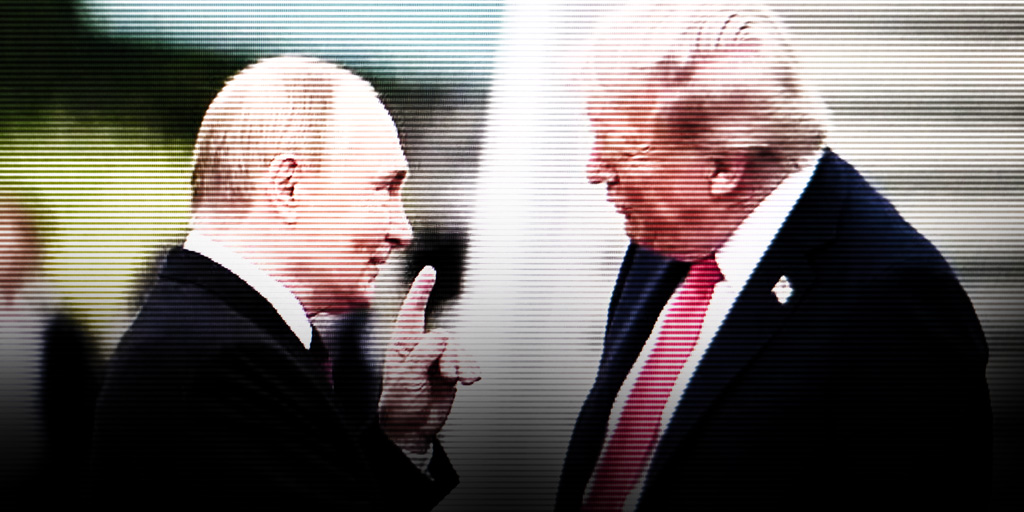
The Trump administration’s ongoing flirtation with the world’s authoritarians has now solidified into what can fairly be described as a Trump Doctrine. The release of Donald Trump’s National Security Strategy, which has been welcomed in Moscow as evidence of Washington’s “alignment with Russia’s vision”, signals something unprecedented: a rapid weakening of America’s long-standing role as a defender of democracy and freedom. What once seemed erratic and rhetorical is now policy. This should alarm every democratic state, and Canada most of all, along with Americans who still understand the cost of accommodating authoritarianism.
Canada and Europe must now prepare to defend the democratic order that the United States once underwrote. That will require a deeper trans-Atlantic partnership and a shift toward an active defensive posture that disrupts and deters authoritarian aggression rather than reacting after the fact as we have for much of the past 25 years.
Canadian and European officials have spent the past year preparing for a world where the United States is less engaged and weaker than at any time in the postwar era. With Washington now drifting toward an alignment with authoritarian powers, that outcome feels increasingly certain. For Vladimir Putin, who has spent more than two decades trying to undermine the United States and fracture the democratic West, this moment is a strategic victory. It strengthens his position and that of his authoritarian partners and increases the likelihood that they will endure and expand within a darker and more fractured global order.
None of this arrived without warning. In the early 2000s, Russian pro-democracy leaders such as Garry Kasparov and Boris Nemtsov repeatedly cautioned the West about Putin’s imperial goals and the kleptocratic group surrounding him. They warned that he was rebuilding the architecture of authoritarian rule in plain view. We heard them, but we failed to act.
Successive American presidents believed they could engage Putin through dialogue and mutual respect. George W. Bush set that tone when he claimed that after looking Putin in the eye he had sensed “his soul.” Senator John McCain took a clearer view, saying he saw only three letters: K, G and B. His warning was largely ignored.
In 2009, Secretary of State Hillary Clinton presented Russian Foreign Minister Sergei Lavrov with a red novelty “reset” button to symbolize a fresh start with Moscow. It was offered even after Russia’s cyberattack against Estonia in 2007 and its invasion of Georgia in 2008. Rather than restraining Putin, the gesture reinforced his sense that aggression would carry no real cost and contributed to enabling the occupation of Crimea in 2014 and the mass crimes committed against Ukraine over the past 4 years.
Many Canadians were also slow to acknowledge the threat. Evidence of Putin’s imperial ambition and worsening repression at home was dismissed as exaggerated or misunderstood, often by those with economic ties or professional interests in Russia. This complacency, including among former diplomats who should have known better, dulled public awareness and contributed to the vulnerabilities we face today.
Russian journalists, activists and opposition figures warned us for years about the character of Putin’s regime and many paid the ultimate price. In 2006, journalist Anna Politkovskaya was murdered in her apartment building after exposing war crimes in Chechnya. That same year, Alexander Litvinenko was assassinated in London using radioactive polonium carried by Kremlin agents. One of those agents, Andrey Lugovoi, was later awarded a seat in the Russian parliament. In 2015, Boris Nemtsov was shot dead within sight of the Kremlin itself. His friend and colleague Vladimir Kara-Murza survived two poisoning attempts before being imprisoned in 2022 for speaking against the invasion of Ukraine.
As Russian opposition leader and chess grandmaster Garry Kasparov reminded me, “Vladimir Putin was never secretive about his plans. He was very clear about his intentions. It was twenty years ago that he said that the collapse of the Soviet Union was the greatest geopolitical catastrophe of the century and he clearly set about his efforts to restore the glory of Russia’s colonial empire.”
This context matters when interpreting Donald Trump’s new security doctrine and the so-called Witkoff peace proposal, which analysts believe was shaped by Putin advisor Kirill Dmitriev in Moscow. It is not a peace plan. It is a capitulation plan that would remove Ukraine’s sovereignty, freeze the conflict on Putin’s terms, and grant Russia the time it needs to rebuild its forces for a broader assault. That wider conflict would not stop at Ukraine. It could reach our allies and even the Canadian Arctic.
Canada and our allies can no longer afford to rely on the hope that Putin might be convinced through gentle diplomacy to persuade the Kremlin to stop killing Ukrainians, to stop persecuting its own citizens, and to stop threatening the democratic world through terror and sabotage.
As authoritarian states organize and align, democratic nations must also align with equal determination. Canada should follow the lead of our Nordic and Baltic allies and adopt a defensive posture that treats information warfare and strategic intimidation as immediate threats to our sovereignty, both physical and cognitive.
The world that allowed us to ignore Putin and his alliance of authoritarians is gone. The one replacing it, will punish those who hesitate.
